
By Nitin Jain, CEO, India PR Distribution

Most brands don’t have a marketing problem. They have a trust problem.
There is a lot of attention in India’s most competitive fields, such as consumer tech, fintech, B2B SaaS, and D2C. Many brands are using Ads, celebrities, and influencers, and yet when you ask customers what they remember, the answer is often silence. Not because brands lack effort, but because they lack consistent proof.
That’s the core misunderstanding about PR. Many teams treat it like an occasional megaphone: a press release for a launch, a push for a milestone, or a burst of coverage around a funding moment. The result is a few spikes, then a return to obscurity. Spikes don’t build authority. Authority is what happens when the market sees your credibility repeatedly, in different forms, across time, until your brand feels inevitable.
Here’s the contrarian view: PR isn’t publicity. It’s an operating system for credibility, and credibility compounds.
The practical implication is simple: stop treating PR like an event. Treat it like publishing. You don’t need twelve “big announcements.” You need twelve story types, twelve proof-led narratives delivered with discipline.
Over the years, I’ve found that marketing leaders succeed with PR when each story includes the following five elements: a clear news peg (why it matters now), proof (data, outcomes, third-party validation), a small set of assets (so the story travels), a deliberate distribution plan (to the correct audiences), and a defined business outcome (pipeline, trust, hiring, partnerships, retention).
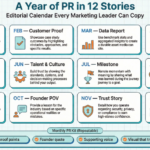
Here is a year-long editorial calendar you can copy. You can run it as January-to-December or treat it as evergreen “Story #1 to Story #12” and start in any month. The sequence matters less than the cadence.
The 12 stories that create a year of PR (start anytime)
1) Category POV: The market shift you see before others do.
You can begin your PR campaign with an opinion that’s earned. A strong category POV answers a question your buyers are already struggling with. Topics like what’s changing, what’s no longer working, and what needs to be done differently. In India, where markets are evolving quickly, leaders who narrate change become reference points.
2) Customer proof: The case study that sells without sounding like sales.
Most marketing content claims value. A customer proof story shows it. The format is straightforward: the obstacle, the approach, and the outcome. If you can’t name the customer, anonymize responsibly (“a mid-sized logistics company,” “a retail chain in North India”) and focus on specifics. In B2B and premium D2C, proof reduces perceived risk, and that is often the real driver of conversion.
3) Data report: A credibility engine that earns attention.
If you want consistent pickup, publish something the market can cite. A data report can be a benchmark, a trend analysis, or an aggregated insight from campaigns. This is where PR intersects with SEO and long-tail authority. A detailed industry report doesn’t just generate a news moment; it becomes a durable asset that media, analysts, and buyers reference over time.
4) Product release: Frame outcomes, not features.
Product updates are rarely news on their own. But customer outcomes are. The mistake teams make is describing “what we built” instead of “what becomes possible now.” The best product PR focuses on the problem the market recognizes, why it matters now, and how the change reduces friction, cost, time, or risk. If your press release story reads like a changelog, it will perform like a changelog.
5) Partnership: Make it a customer story, not a logo story.
Meaningful partnerships signal authority. The story is not “we partnered.” The story is “two capabilities combine to remove a real bottleneck.” Explain what changes operationally for customers, what’s integrated, and why the partnership makes something easier, faster, safer, or more accessible.
6) Talent and culture: Show how quality is built.
Culture stories build trust differently. They show the standards behind the output. Hiring principles, training systems, QA processes, and “how we make decisions” are credibility assets.
7) Milestone: Momentum with meaning.
Milestone PR works in establishing trust. The best milestone stories explain what was learned, what changed, and why the progress matters for customers. Instead of celebrating the number, narrate the story behind the number.
8) Impact/CSR: Measurable change, not emotional branding.
Impact stories are increasingly scrutinized. The era of vague “we care” messaging is over. If you publish CSR, publish what you did, who you did it with, what changed, and what you measured. Done right, impact becomes part of brand character. If done poorly, it can become a credibility risk.
9) Expansion: The “why now” story.
Market expansion is not just geography; it’s a strategy. The strongest expansion narratives explain the demand signal, the customer pull, what you learned about the segment, and why the timing is right. India’s diversity makes this especially important: moving from one city, language, or region to another can be a case study in customer insight if you tell it well.
10) Founder POV: The leadership lesson that the market can use.
A founder story becomes powerful when it is not an autobiography. The point is to translate experience into an insight for the industry: a mistake that taught you how trust is built, a lesson about positioning, or the operational reality behind “success.” In a world where audiences are skeptical, specificity is the antidote to cynicism.
11) Trust story: How you earn confidence when the stakes are high.
Every serious brand needs a trust narrative: security, privacy, compliance, governance, quality control, reliability, and crisis readiness. The objective is to replace “trust us” with “here’s how we operate.” For marketing leaders in regulated or high-consideration categories, this is often the difference between being shortlisted and being ignored.
12) Year-in-review + predictions: Leadership without fortune-telling.
Close your cycle with the three shifts you observed, what worked, what didn’t, and what marketing leaders should prepare for next. Predictions should be grounded in evidence, not drama. This is where you can “own the narrative” for your category and set up the next year’s POV.
If you prefer a January-to-December calendar, you can map these in the same order: Category POV (Jan), Customer proof (Feb), Data report (Mar), Product release (Apr), Partnership (May), Talent/culture (Jun), Milestone (Jul), Impact (Aug), Expansion (Sep), Founder POV (Oct), Trust story (Nov), Year-in-review/predictions (Dec). If your business has seasonality, swap months. The cadence matters more than the date.
Make it repeatable: the monthly PR kit
PR only compounds when it’s operational. The simplest way to avoid “heroic effort” cycles is to standardize what ships each month. In practice, that means every story needs a tight news peg, three proof points, a founder quote that sounds like a human (not a brochure), one supporting voice when possible, a visual that travels (a simple chart or framework), and a permanent news section on your website so the story can be found later.
One monthly press release can become a newsroom post, a press note, a founder LinkedIn POV, a short video insight, an internal sales one-pager, an email to customers, and a concise investor update. The operating principle is simple: publish proof, not promises. If you want PR that supports marketing outcomes, stop asking, “Do we have news?” Ask, “What proof do we have this month, and how do we package it into a story the market can remember?”
Repeat that twelve times a year, and credibility stops being a hope. It becomes an asset.
Author Profile

- Nitin Jain - C.E.O - India PR Distribution
- Nitin Jain is the founder and C.E.O of India PR Distribution - India's top Press Release Distribution and PR Agency. Nitin has more than 20 years of experience in PR, Corporate Communications, Digital Marketing, Branding Strategy and Lead generation.
Latest entries
 Press Release TipsMarch 31, 2026The Best Press Release Distribution in 2026: What Works, What Doesn’t, and How to Pick Right
 Press releaseJanuary 31, 2026A Year of PR in 12 Stories: The Editorial Calendar Every Marketing Leader Can Copy
 EntrepreneursJanuary 5, 2026Nitin Jain Entrepreneur Behind India PR Distribution Success
 Press releaseNovember 20, 2025Meet Nitin Jain: CEO of India PR Distribution
